
- Home
- About
- Admissions
- Academics
- Alumni Relations
- Careers
- Contact Us
COLLEGE OF CRIMINAL JUSTICE
HISTORY OF THE COLLEGE OF CRIMINAL JUSTICE
The College of Criminal Justice is one of colleges with program offering of Bachelor of Science in Criminology. The BS Criminology program was offered upon the establishment of the City College of Manila on 1995 upon the enactment of Manila City Ordinance 7885 on April 26, 1995 creating the City College of Manila. The BS Criminology offering was managed and administered by the Department of Criminology and Public Administration under the School of Behavioral Sciences. The College was situated in the Old PNB Building at the historic street of Escolta, Sta. Cruz, Manila. The program produced its first batch of graduates in the year 1999. As enrollment grows, the Department of Criminology was elevated thereby creating the School of Criminology in the year 2000.
Upon the enactment of the Manila City Ordinance 8120 on June 26, 2006 renaming the City College of Manila to Universidad de Manila. The elevation of the institution from college to university led to elevation of the School of Criminology to college, consequently renamed it to College of Criminology. Likewise on the same year, the College has transferred to its new campus in Mehan Gardens at Cecilia Muñoz-Palma Street. The College produced its first university graduates in 2007. In 2019, the College was renamed as the College of Criminal Justice.
MANDATE AND FUNCTIONS
The College of Computing Studies is mandated to provide high-quality education in Information Technology while its core functions include curriculum development, research, industry linkages, and community extension service that will prepare students to become competent IT professionals who can meet and deliver the changing demands of the industry and society.
CCJ VISION
- A cradle of nation’s best criminologists, criminal justice professionals, and public safety and security officers who are equipped with theoretical knowledge, practical skills and moral values in addressing the problem of local and transnational crimes, and the competence to meet the challenges of global policing.
CCJ MISSION
- To provide the community with professionally competent, service oriented, and morally upright graduates who can deliver efficient and effective crime prevention, law enforcement and public safety and security services among others; credible and scientific crime detection and investigation; humane custody and rehabilitation of criminal offenders; and scientific criminological researchers.
CORE VALUES
Excellence, Fortitude, Service
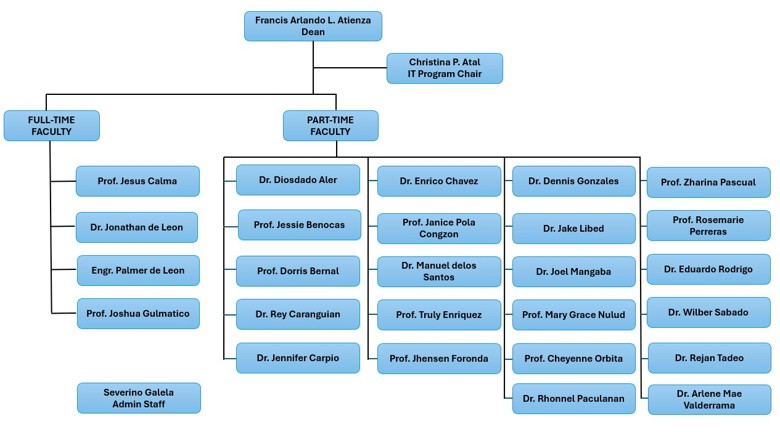
CCS Organizational Chart
College Logo

The logo represents the College of Computing Studies (CCS), formerly the College of Engineering and Technology (CET). The change reflects the college’s shift toward a stronger focus on computing and digital innovation. Each element of the logo reflects our mission to grow, lead, and produce technology-literate graduates ready for the modern world.
College Color
Turquoise Blue
Represents technology, innovation, and creativity, reflecting the college’s identity as a community focused on computing and digital innovation.
Green
Represents growth, progress, and development, symbolizing the continuous improvement of CCS and its students while embracing new opportunities.
OFFICE RECOGNITION/AWARD/ACHIEVEMEMT/DISTINCTIVE STRENGTH
The college is recognized as a top performing school in NCR by the Professional Regulations Commission for being consistent in having the highest passing rate in Criminologist Licensure Examination (CLE) among HEIs in NCR, and one of top performing schools in Criminologists Licensure Examination in the nation. In 2026, the College landed 9th Place in Category B in the CLE.
MESSAGE FROM DEAN/DIRECTOR

Dean, College of Computing Studies
Over the past years, the digital world has continued to change dramatically. The emerging technologies such as artificial intelligence, data analytics, robotics, cloud or edge computing, and Human-AI collaboration are reshaping industries and redefining the way people learn, work, communicate, and think. As an IT student, it is with great responsibility to heed the call and adapt to these changes but to learn and explore them with utmost integrity along with the highest ethical standards.
As you, BSIT students journey to the 4-year academic learning at Universidad de Manila, carry with you the values of excellence, x-factor innovation, collaboration, empowerment, and leadership with humility. Use your skills and talents not only to build applications, tools or models but also to empower communities and contribute to the college’s growth and the society as well.
The future of technology doesn’t rely on machines alone—it is strengthened by YOU who use knowledge wisely and responsibly.
ACADEMIC PROGRAM
Bachelor of Science in Criminology
The BS Criminology program offering was mandated by the then Republic Act 6506 which was repealed by RA 11131 known as The Philippine Criminology Profession Act of 2018, and the CHED Memorandum 5 series of 2018 known as Policies, Standards and Guidelines for the Bachelor of Science in Criminology Program. The program encompasses the curriculum designed for the study of crime and various agencies of criminal justice as they operate to react in crime, criminals and victims.
Career Competencies
Career Competencies for criminologists are provided by the CMO 5 Series of 2018 and other relevant laws, rules and regulations; likewise, these are incorporated in program learning outcomes. These competencies are;
- Engage in lifelong learning and understand the need to keep abreast with the developments in the field of practice;
- Communicate effectively;
- Work effectively and independently in multi-disciplinary and multicultural teams;
- Practice professional, social and ethical attitudes, values, and responsibilities;
- Appreciate and value “Filipino historical and cultural heritage” and uphold Constitutional and statutory guarantees;
- Conduct criminological research on crimes and juvenile delinquency, crime etiology, victims and offenders, deviant behavior and agencies that handle;
- Internalize the concepts of human rights, gender and multicultural differences, and victims’ welfare;
- Demonstrate competence and broad understanding in law enforcement administration, public safety and security, community policing, public safety and security and criminal justice;
- Utilize criminalistics or forensic science in the investigation and detection of crimes;
- Apply the principles and jurisprudence of criminal law, evidence and criminal procedure;
- Ensure offenders’ rehabilitation, welfare, development and reintegration to the community;
- Participate in the generation of new knowledge or in research and development projects;
Support national, regional and local development plans.
Career Opportunities
Registered criminologists are privileged for the following government positions pursuant to the RA 11131;
- Dactylographer
- Ballistician
- Questioned Document Examiner
- Forensic Photographer
- Polygraph Examiner
- Probation Officer
- Parole Officer
- Special Investigator
- Special Agent
- Investigative Agent
- Intelligence Agent
- Law Enforcement Evaluation Officer
- National Police Commission NAPOLCOM Inspector
- Traffic Operation Officer
- Associate Graft Investigation Officer
- Special Police Officer
- Safekeeping Officer
- Sheriff
- Security Officer
- Criminal Investigator
- Warden
- Reformation Officer
- Firefighter
- Fire Marshall
- Jail Officer up to the rank of Jail Superintendent
- Police Officer up to the rank of Police Superintendent and other law enforcement agencies, and agencies under the Criminal Justice System.
Industry Partners
The college is engaged in the following industry partners particularly in internship;


- PNP
- BJMP
- BFP
- PPA
- MYRC
- MDRRMO
- CSF
- BI
Alumni Testimonial
ROLITO M. GERONIMO
"My college experience at Universidad de Manila played an important role in my academic, personal, and professional growth. As a Bachelor of Science in Information Technology student, I gained a strong foundation in computer systems, troubleshooting, software, networking, and other areas of information technology. Beyond academics, my internship provided me with hands-on experience in assisting users, resolving technical concerns, setting up computer systems, and supporting daily IT operations.
My involvement in student organizations also helped me develop my communication, teamwork, leadership, and organizational skills. These experiences taught me how to work with different people, handle responsibilities, and remain adaptable when facing challenges.
The knowledge, skills, and experiences I gained throughout college prepared me for my professional career as a Technical Support Representative. Universidad de Manila helped me become more confident in applying what I learned in real-world situations and taught me the importance of patience, problem-solving, continuous learning, and providing proper assistance to users. I am grateful for the opportunities and experiences that helped shape me into the professional I am today."
PRINCESS KHARYLL L. MORALES
"Every milestone I’ve reached academically, personally, and professionally traces back to my foundation at the Universidad de Manila (UDM) College of Computing Studies. Navigating a challenging technical curriculum provided the fundamental architecture for my technical skills, while hands-on capstone research and complex coursework sharpened my real-world problem-solving framework. Serving as class president, where acting as both a supportive team player and a student leader taught me how to guide and collaborate effectively under pressure.
Outside the classroom, my personal development was driven by active leadership in student council and department events. Serving the student body allowed me to develop strong resilience, accountability, and teamwork under pressure. The support of passionate faculty alongside real-world internship experience ensured a seamless transition into the industry. UDM equipped me with both the technical expertise and leadership background needed to navigate today’s evolving digital landscape.
Entering a technical field that is rapidly evolving alongside the rise of AI requires true adaptability, agility, and vision. All of which were cultivated during my time at UDM. I am proud to carry forward the values of integrity, continuous growth, and excellence embedded in me."
KYLE SHANE G. SABINO
"Universidad de Manila, particularly the College of Engineering and Technology (now the College of Computing Studies), has helped me develop my skills not just in system development but also in workplace professionalism. Academically, UDM has boosted my skills, specifically in system design and development. With the help of the programming languages, frameworks, and approaches that my former professors and instructors have instilled in us, it has helped me solve complex problems, specifying first what the end-users need, and make processes even more efficient, which is now applicable in my current work as I manage, develop, and enhance two of the most important hospital-based systems in my current institution.
Within the university and my beloved college, I have witnessed their efforts and shared their knowledge and expertise to become better once we enter the industry. On the other hand, being the voice that I was, representing the students before as a Supreme Student Government officer for two years has boosted the way I interact with my colleagues.
Lastly, I can proudly say that the Universidad de Manila, through its core values or E.Q.U.A.L., has allowed me to show quality, excellence, and pride as a proud Merlion, as well as unity and collaboration with the team that I am working with, and leadership and innovation - which guided me to share more ideas that I think could help for the betterment of not just our division, but also our main clients - the Filipino people."
KIRBY SEMBRANO
"My college experience as a Bachelor of Science in Information Technology student played a significant role in shaping both of my personal and professional growth. Throughout my studies, the institution provided me with valuable knowledge and practical skills that prepared me for the demands in the IT industry.
Beyond technical subjects, my college experience taught me the importance of discipline, teamwork, communication, problem-solving, and adaptability. Through projects, activities, and hands-on learning, I gained confidence in applying what I have learned in real-world situations. The guidance and support of my instructors also encouraged me to continuously improve and pursue opportunities where I could further develop my skills.
After graduating in 2024, I was able to apply the knowledge and experiences I gained in college to my current role as an IT Support Assistant. The foundation I built during my studies has helped me handle technical challenges, support users, and approach problems with greater confidence and professionalism. I am grateful to my college for providing an environment that helped me grow not only as an IT professional but also as an individual. The experiences and lessons I gained will continue to guide me throughout my career. "
ACTIVITIES
Research and Innovation
- EAT-Seismic Sentinel Initiative: Building an AI-Enabled University Ecosystem for Earthquake Resilience, Life Safety, and Community Protection Emergency Action Team (EAT) on Earthquake Safety Protocols as a Flagship AI-Driven Disaster Resilience Research Program, Innovation Congress International Research Conference on Pharmaceutical and Allied Sciences – Dr. Jonathan De Leon
- A Smart Collaborative Learning Platform using NLP, Deep Learning Models, and Recommendation Algorithm for Automated Content Generation, International Journal of Research and Innovation in Applied Science – Dr. Rhonnel Paculanan, Prof. Francis Arlando L. Atienza, Dr. Rejan L. Tadeo, Prof. Jesus B. Calma, Prof. Christina Atal, Prof. Joy Sadol
- Latent Profile Analysis of Learned Helplessness in Mobile Mathematics Learning: A Behavioral Perspective, International Conference on Innovations in Computational Intelligence and Computer Vision – Prof. Francis Arlando L. Atienza, Dr. Rex P. Bringula, Dr. John Paul P. Miranda
- Development and Evaluation of a Math mCSCL Platform with Aggregated Content-Based Filtering and Guessing Detection, Journal of Artificial Intelligence and Technology – Prof. Francis Arlando L. Atienza, Dr. Rex P. Bringula, Dr. John Paul P. Miranda
Extension and Community Engagement
The college has launched the project BAWSO (Barangay Animal Welfare Safety Officer) that aims to promote observation of animal welfare, public awareness, public sanitation, responsible pet ownership, and local government capacity building for the adopted community. The college has initiated the project by consultation, orientation to proposed program and proposed ordinance, donating cage, and proposing a model ordinance.
Internships and Industry Immersion
The criminology interns of Class 2025-2026 have successfully finished internship program with industry partners composed of criminal justice agencies. Interns have completed 540 hours of OJT through the entire school year. This school year another class, the Batch SANDIGLAKAN of 2026-2027 will immerse with the partner institutions.
- Schools Division Office of Manila
- Philippine Ports Authority
- Highpoint Services Network Philippines, Inc.
- Oriole Dynamic Int’l. Corp.
- Bureau of Customs
- COMELEC
- R2 Group of Exclusive Brands
- MicroData
- First Unity Textile Mills
- Civil Service Commission Field Office
- Pamantasan ng Lungsod ng Maynila
- Poseidon International Maritime Services, Inc.
- Crowe
- Namayan Digital, Inc.
- Nexus Cloud IT Solutions, Inc.
- NRK Digital Media
- Municipality of Gerona, Province of Tarlac
- CUBED Technologies
- ADHI-PTPP Joint Venture
- National Bureau of Investigation
- Adventus
- Bespoke IT Project Corp.
- Transfer IT
- iHyvePh
- C’SCOR Global Intertrade Corp
- UP Manila Disaster Risk Education and Management Health Center
- Lungsod ng Maynila – Public Employment Service Office
- Deparment of Social Welfare and Development
- CompMan – Competence Management & Consultancy Inc.
- Kaizo Enterprises Co.
- San Juan Medical Center
- One Outsource
- Bye Bye Pinas Inc.
- Atlanta Industries
- Concentrix
- SK Federation Office
- Four R Customs Brokerage (OPC)
- Chinabank
- CREMPCOOP
- City of Manila – Office of the Accountant
- Department of Tourism – Culture and Arts Manila
- Columbia Trchnologies, Inc.
- SPARKLE Star International Corporation
- Cultural Center of the Philippines
- ArchEn Technologies, Inc
- Converge, ICT Solutions Inc.
- D.M. Consunji, Inc.
- Teleperformance
- Co Ban Kiat Hardware Inc.
- Arthur John Collection Agency Inc.
- Fast Forward Freight Forwarding Inc.
- OLLOPA Corporation
- HSTI
- MC MAXCOR Inter-ventures Co.
- Blue Orion Recruitment Services Corp.
- APPTrade
- Universidad de Manila
- Office of the University Registrar and CMIT
STUDENT ACHIEVEMENTS
- For school year 2025-2026 six of the graduating class graduated Cum Laude they are; Thessalonica D. Carmona, John Arcel David, John Paul Cañada, Symoun Yurik C. San Diego, Ian Christ John R. Geronimo, and Romelyn Reyes
- In 2026, the Maharlika Awardee was conferred to Ms. Thessalonica D. Carmona; the College Achiever Award was conferred to Carl Rayven Sales
FACULTY ACHIEVEMENT
Atty. Rodolfo V. Castillo, Jr., the most tenured faculty in the CCJ was awarded the City Service Loyalty Award. He has been serving the university for more than 30 years since 1995 and handed various positions in the university. He is a mentor for all individuals within the UdM community, especially in the College of Criminal Justice from which he started as a faculty member.
STUDENT ORGANIZATION
Criminology Executive Council
The Criminology Executive Council is a local student council of the College of Criminal Justice. The CEC is unique for being a presidential in form and parliamentary in character. Class president of each class serves as a representative of the class in the council, and among representatives, executive officers are selected in parliamentary voting every year.
Facebook Page: Universidad de Manila Criminology Executive Council
- ccj@udm.edu.ph

Universidad de Manila
Former City College of Manila
Contact Details
- registrarsoffice@udm.edu.ph
- treasuryoffice@udm.edu.ph
- udmalumni.official@gmail.com
Main Campus
659-A Cecilia Muñoz St, Ermita, Manila, 1000 Metro Manila
Henry Sy. Campus (Annex)
Carlos Palanca, Santa Cruz, Manila, 1003 Metro Manila